
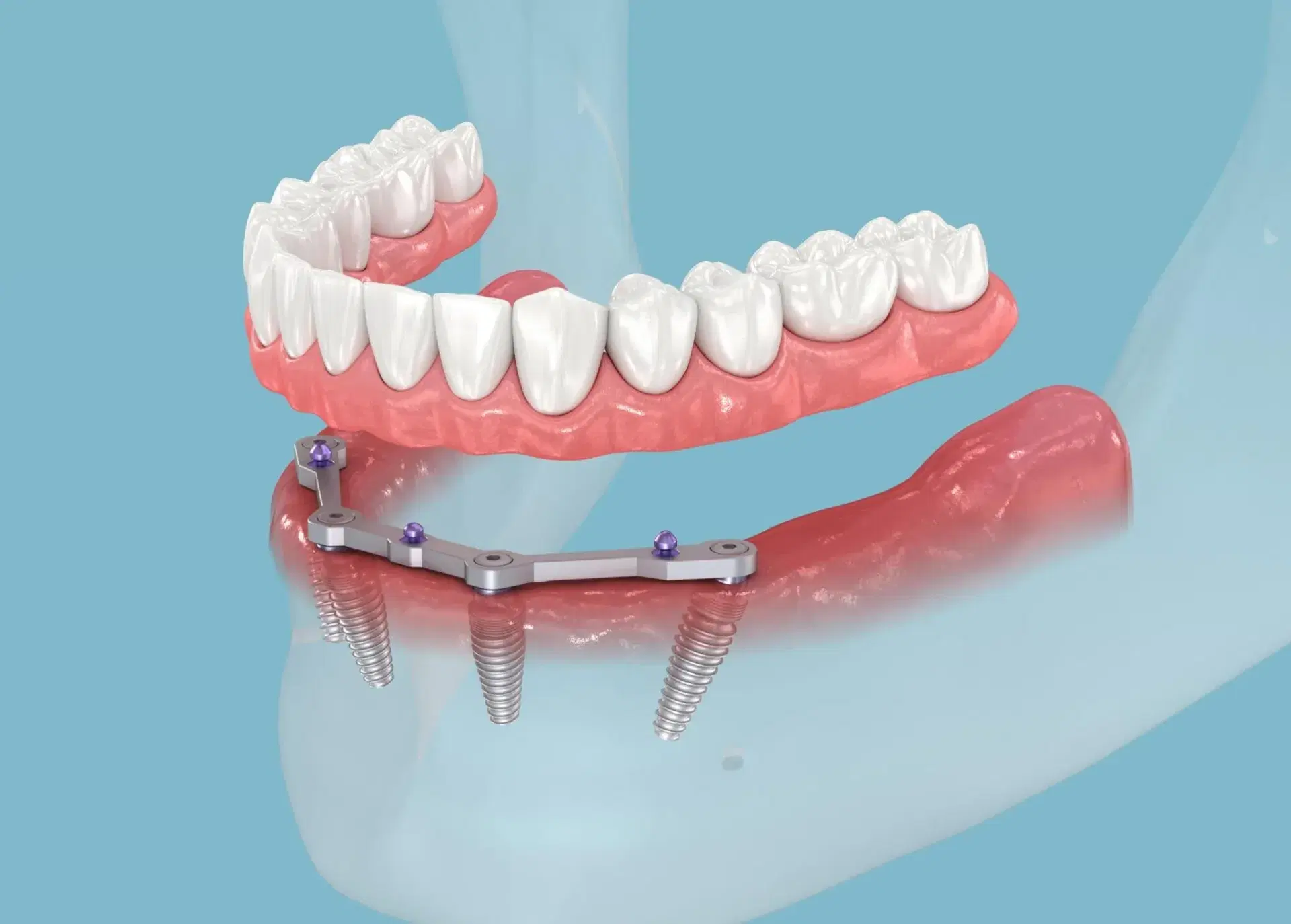
All-on-4 dental implants support a fixed full-arch bridge using four strategically positioned implants. The original concept uses two straight front implants and two tilted rear implants. Tilting can avoid anatomical structures and reduce the unsupported bridge extension. However, same-day teeth remain provisional and depend on strong primary implant stability. Four implants represent a minimum, not an automatic best choice for every jaw. Long-term success also requires cleanable prosthetic design, daily hygiene, and professional maintenance. Planning should consider future implant loss, bone quality, bite forces, and repair access.
What Is All-on-4 Dental Implants?
All-on-4 dental implants are a full-arch tooth replacement method that supports a fixed set of artificial teeth with four implants. The dentist places the implants into the jawbone, usually using two front implants and two angled rear implants. This positioning helps distribute chewing forces while using the available bone efficiently.
The treatment may suit patients who have lost most or all teeth in one jaw, or whose remaining teeth cannot be preserved. A temporary fixed bridge may sometimes be attached shortly after surgery, but same-day teeth are not suitable for every patient. Bone condition, gum health, implant stability, general health and oral hygiene affect treatment planning.
All-on-4 does not replace every missing tooth with a separate implant. Instead, four implants support one connected upper or lower dental arch. A clinical examination and three-dimensional imaging are necessary to determine whether this approach is appropriate for you.
Why Are the Posterior Implants Tilted?
Tilting the posterior implants increases implant distribution while avoiding selected nerves, sinuses, and severely resorbed bone.
The angle allows surgeons to use more available bone toward the front. It can also move the implant connection farther backward. This positioning shortens the prosthetic cantilever behind the final implant. Shorter cantilevers can reduce unfavorable leverage during chewing. Tilting does not automatically weaken an implant. Reviews have found similar survival outcomes between tilted and upright implants. However, the planned angle must match bone anatomy and prosthetic requirements. Excessive or poorly positioned angulation can complicate cleaning, screw access, and future repairs.
Does All-on-4 Always Provide Teeth in One Day?
All-on-4 can provide a fixed provisional bridge quickly, but same-day teeth are not guaranteed for every patient.
Immediate loading requires sufficient stability from every implant supporting the bridge. The clinician evaluates insertion resistance, stability measurements, bone quality, and implant distribution during surgery. If stability remains inadequate, loading should be delayed. Additional grafting may also change the planned schedule. Immediate loading technically means connecting an implant to a functioning prosthesis within one week. Therefore, marketing phrases may simplify the clinical definition. Patients should also understand that immediate teeth are usually provisional. The definitive bridge normally follows healing and tissue stabilization.
Who Is Suitable for All-on-4 Dental Implants?
Suitable candidates have complete tooth loss, failing remaining teeth, usable jawbone, and manageable medical risks.
The assessment should consider several connected factors:
Remaining teeth must receive a fair preservation assessment before extraction.
Bone must support four appropriately distributed implants.
Implant positions must allow a functional and cleanable bridge.
Medical conditions should permit surgery and predictable healing.
Patients must manage daily cleaning beneath a fixed prosthesis.
Severe grinding may require additional protective planning.
Smoking and previous periodontal disease may increase maintenance concerns.
Expectations must match the treatment’s biological and mechanical limits.
Three-dimensional imaging and prosthetic planning should precede irreversible extractions.
Does All-on-4 Always Avoid Bone Grafting?
All-on-4 often reduces grafting requirements, but it cannot eliminate grafting in every anatomical situation.
Tilted posterior implants can bypass the maxillary sinus or mandibular nerve region. This strategy may use existing bone more efficiently than parallel posterior implants. However, some jaws lack sufficient bone even within the intended implant zones. Bone augmentation may also improve implant distribution or support additional implants. Extraction defects and thin facial bone can require separate management. Severe upper-jaw resorption may need short, trans-sinus, or zygomatic implant alternatives. Therefore, “graft-free” describes a common objective rather than a universal promise. Final decisions require three-dimensional imaging and restorative planning.
How Successful Are All-on-4 Dental Implants?
All-on-4 implants show high survival rates, but survival does not mean complication-free clinical success.
A systematic review reported approximately 99% implant survival after three years. The same review found that 74% of recorded implant failures occurred during the first year. This timing makes early healing and loading control particularly important. Implant survival simply means the implant remained in place. Success may additionally consider bone stability, infection, comfort, appearance, function, and maintenance requirements. A bridge can remain functional while needing screw tightening or tooth repairs. Patients should therefore ask clinics to report implant survival, prosthesis survival, and complication rates separately.
Are Four Implants as Reliable as Six Implants?
Four implants can support a complete fixed bridge, but six implants may offer different mechanical and contingency advantages.
ITI guidance recommends at least four appropriately distributed implants for a one-piece fixed full-arch prosthesis. Reviews generally show no significant survival difference between fewer than five and additional implants. However, survival rates do not capture every practical distinction. A five-year randomized maxillary trial reported more technical complications with four implants than six. Additional implants may improve distribution or provide options after a later implant problem. Conversely, six implants require suitable bone, added surgery, and higher treatment complexity. The prosthetic plan should determine implant number.
What Happens If One All-on-4 Implant Fails?
One failed implant can compromise the treatment because four implants represent the minimum recommended support for the complete bridge.
The consequences depend on the failed implant’s position, timing, and remaining bone. An early failure may require removing the provisional bridge or reducing its loading. The clinician may replace the implant after healing or choose another available site. Some cases require an additional implant, grafting, or a redesigned prosthesis. A temporary removable option may become necessary during recovery. Continued use on three implants can overload the remaining support. Treatment planning should therefore include a documented rescue strategy before surgery. Additional implants can provide more restorative options after future complications.
What Is the Difference Between the Temporary and Final Bridge?
The temporary bridge protects healing implants, while the final bridge provides the planned long-term shape, strength, and surface quality.
Clinicians usually fit the provisional bridge soon after surgery when stability permits. This bridge often uses acrylic materials and follows a restricted bite design. The healing period allows clinicians to evaluate speech, appearance, cleaning access, and jaw relationships. Acrylic tooth or bridge fracture represents a commonly reported early prosthetic complication. The final restoration may use reinforced acrylic, metal-ceramic, or zirconia-based construction. No material completely removes maintenance requirements. Material selection should consider bite forces, repairability, available space, opposing teeth, appearance, and cost.
What Complications Can All-on-4 Treatment Cause?
All-on-4 treatment can cause surgical, biological, and mechanical complications despite high implant survival.
Early problems include pain, swelling, bleeding, infection, altered sensation, and implant instability. Later biological problems include peri-implant mucositis, peri-implantitis, and progressive supporting bone loss. Mechanical complications include acrylic tooth fractures, screw loosening, screw fractures, and framework damage. Speech changes or food trapping can follow unsuitable bridge contours. An unattractive transition line may appear when smiling exposes the prosthesis junction. Excessive cantilever length can increase mechanical stress. Regular reviews help identify inflammation and loosened components before greater damage develops.
How Do You Clean All-on-4 Dental Implants?
All-on-4 bridges require cleaning above and beneath the prosthesis every day.
Effective maintenance should include the following measures:
Brush the visible bridge and gumline at least twice daily.
Clean beneath the bridge using suitable interdental brushes.
Use floss designed for bridges when the available space permits.
Consider a water flosser as an additional cleaning aid.
Follow personalised instructions for implant sites and bridge contours.
Attend professional maintenance appointments at recommended intervals.
Report bleeding, swelling, bad taste, movement, or persistent discomfort.
Avoid using sharp objects beneath the prosthesis.
A smooth, non-concave bridge base can improve cleaning access and reduce plaque retention.
How Long Does All-on-4 Treatment Take?
All-on-4 treatment may deliver provisional teeth quickly, but complete rehabilitation usually requires several months.
Planning begins with examination, imaging, photographs, impressions, and bite analysis. Necessary extractions and implant placement may occur during one surgical appointment. Suitable patients can receive a fixed provisional bridge shortly afterward. Healing then allows osseointegration and tissue remodeling around the implants. The clinical team monitors hygiene, bite forces, stability, and provisional bridge performance. After healing, the final bridge requires new records and technical production. Complications, grafting, poor stability, or medical factors can extend treatment. Clinics should provide separate timelines for surgery, provisional teeth, healing, and definitive restoration.
What Should You Ask Before Choosing All-on-4?
You should ask questions revealing whether the clinic has planned surgery, prosthetics, maintenance, and possible failure management together.
Request a clear explanation covering:
Why are four implants preferable for your specific jaw?
Can any remaining teeth reasonably receive preservation treatment?
What happens if immediate loading becomes impossible?
Which provisional and final bridge materials will the clinic use?
Who designs, places, and maintains the restoration?
How will you clean beneath the finished bridge?
What repairs does the quoted treatment include?
What happens if one implant fails?
How often will professional maintenance occur?
Which alternative treatments remain available?
Avoid guarantees involving painless treatment, permanent results, or lifelong complication-free use.