
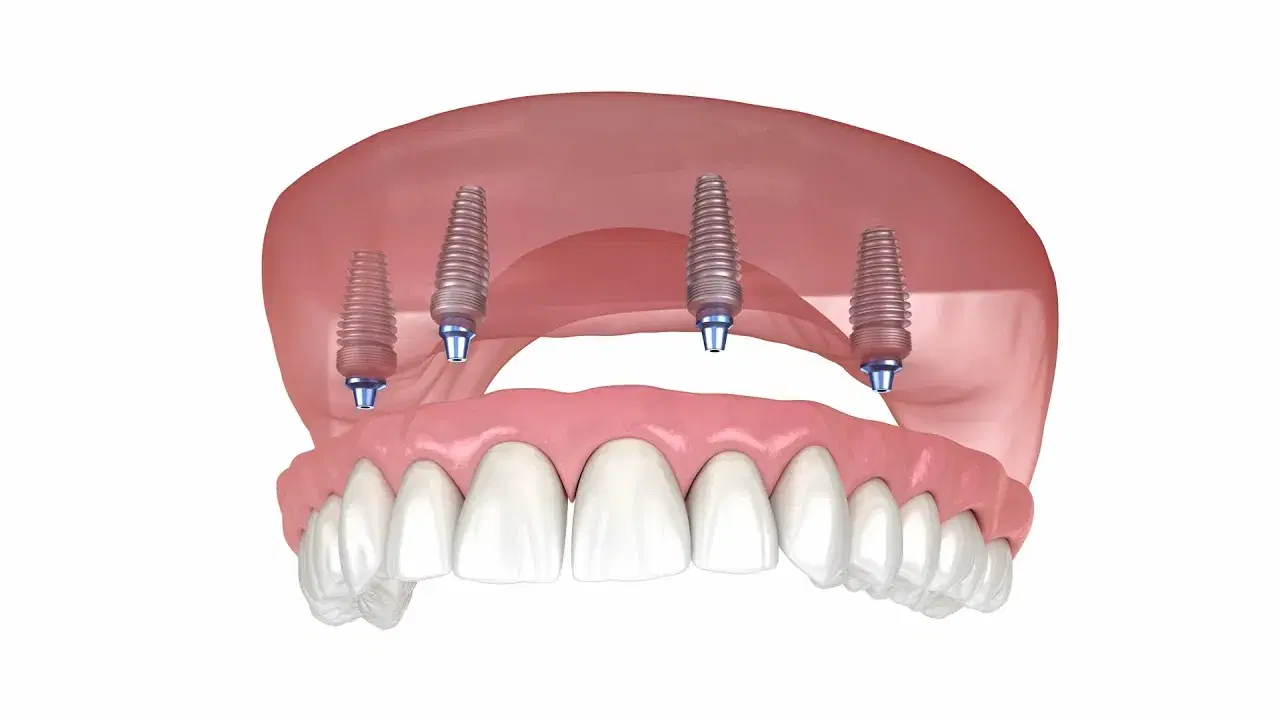
What Is the Main Difference Between All-on-4 and All-on-6?
The main difference is that All-on-4 supports a full-arch fixed prosthesis with four implants, while All-on-6 uses six implants across the same dental arch.
All-on-4 commonly uses two anterior implants and two posterior implants that may be tilted to maximize available bone. All-on-6 distributes the prosthetic load across six implants and can provide additional support when anatomy permits. However, two extra implants do not automatically make All-on-6 clinically superior. A 2026 meta-analysis found broadly similar survival and complication outcomes between both concepts. The appropriate number depends on bone distribution, prosthetic design, implant stability, and treatment objectives.
What Is All-on-4 Dental Implant Treatment?
All-on-4 replaces a complete arch of missing teeth with a fixed prosthesis supported by four strategically positioned dental implants.
The posterior implants are often tilted when this helps use available bone and reduces the need to extend the prosthesis excessively behind the implants. Tilting can also help avoid anatomical structures in selected upper and lower jaws. Research supports four implants as a viable minimum for many fixed full-arch rehabilitations. Long-term evidence has documented high implant survival, while recent comparative analysis found survival above 98 percent after five years or longer. Proper implant distribution remains more important than simply placing four fixtures.
What Is All-on-6 Dental Implant Treatment?
All-on-6 supports a complete fixed dental arch with six implants distributed through available jawbone instead of relying on four supporting fixtures.
Adding two implants can increase the number of support points underneath the prosthesis and may distribute functional forces across a broader area. This can be useful when sufficient bone exists and implant positions allow an effective prosthetic design. Six implants may also reduce dependence on individual fixtures when all implants integrate successfully. However, recent pooled evidence does not demonstrate clearly superior implant survival compared with All-on-4. Therefore, All-on-6 should be selected for anatomical and biomechanical reasons rather than because six is automatically better than four.
Is All-on-6 Stronger Than All-on-4?
All-on-6 can distribute forces across more implants, but clinical evidence does not show that this automatically produces better survival than All-on-4.
Biomechanical studies suggest that increasing implant numbers can reduce stress under certain loading conditions. However, other models show little change when implant position and cantilever length are already favorable. A 2026 comparative study also reported more favorable stress distribution with six implants. Clinical evidence remains more important than laboratory mechanics, and recent meta-analysis found very similar long-term survival. Consequently, prosthetic design, posterior support, implant position, bone quality, and cantilever length can matter as much as the number of fixtures.
Does All-on-6 Have a Higher Implant Survival Rate?
Current evidence does not show a consistent survival advantage for All-on-6 over All-on-4 in full-arch fixed rehabilitation.
A 2026 meta-analysis found one-year pooled survival of 99.20 percent for All-on-4 and 100 percent for All-on-6. At one to five years, the figures were 99.66 percent and 98.55 percent. Beyond five years, pooled survival was 98.14 percent for All-on-4 and 97.50 percent for All-on-6. A randomized five-year trial also found comparable outcomes between four and six implants. These results show that implant number alone is not a reliable predictor of long-term survival.
Is Bone Loss Different Between All-on-4 and All-on-6?
Marginal bone loss is broadly comparable between All-on-4 and All-on-6, although some pooled data show slightly lower long-term measurements around six implants.
The 2026 meta-analysis reported short-term marginal bone loss of approximately 0.77 mm with All-on-4 and 0.85 mm with All-on-6. At longer follow-up, pooled values reached approximately 1.28 mm and 0.94 mm respectively. However, study heterogeneity means these differences require cautious interpretation. A five-year randomized comparison found no significant marginal bone-level difference between four and six implants. Bone maintenance also depends on inflammation control, implant positioning, prosthetic design, smoking, hygiene, and loading.
What Determines Whether Four or Six Implants Are Used?
The choice between four and six implants depends primarily on jaw anatomy, available bone, implant distribution, prosthetic design, and the stability achievable during surgery.
Important planning factors include:
Available bone height and width
Bone quality in potential implant positions
Upper or lower jaw anatomy
Location of the maxillary sinuses
Position of important nerves
Desired posterior implant distribution
Expected cantilever length
Primary implant stability
Need for immediate loading
Existing bone graft requirements
Bite forces and parafunctional habits
Space needed for hygiene and maintenance
These variables matter more than selecting a treatment from implant number alone.
Which Option Requires More Bone?
All-on-6 generally requires suitable bone at more implant positions, while All-on-4 can sometimes work around anatomical limitations using strategically tilted posterior implants.
This distinction is especially relevant in the posterior upper jaw, where sinus expansion and bone resorption can restrict conventional implant placement. Tilting posterior implants can use available anterior bone while reducing distal cantilever length. Six implants may be straightforward when sufficient bone is distributed across the arch. When posterior bone is severely deficient, placing six well-positioned implants can require additional augmentation. All-on-4 was partly developed to achieve fixed full-arch rehabilitation with fewer implants while using available bone efficiently.
Does All-on-4 Reduce the Need for Bone Grafting?
All-on-4 can reduce the need for bone grafting in selected jaws by tilting posterior implants toward regions with usable native bone.
Tilting does not eliminate grafting in every patient. Severe ridge deficiency may still prevent implants from achieving adequate primary stability or safe positioning. However, avoiding anatomical structures can allow treatment without rebuilding every deficient posterior region. A multicenter randomized trial found that rehabilitation using four implants can provide a cost-effective approach while helping avoid some augmentation procedures. Six implants can also be placed without grafting when suitable bone exists. The decision therefore depends on three-dimensional bone anatomy rather than the treatment name alone.
Can Both All-on-4 and All-on-6 Use Immediate Loading?
Both All-on-4 and All-on-6 can support immediate fixed provisional teeth when implants achieve sufficient primary stability and the prosthesis controls functional loading.
Immediate loading means attaching a provisional restoration shortly after implant placement rather than waiting several months without fixed teeth. The implant number alone does not determine eligibility. Bone quality, insertion stability, implant distribution, occlusion, prosthetic rigidity, and surgical conditions all influence the decision. Randomized and long-term studies have reported predictable immediate-loading outcomes with both four and six implants. The provisional bridge still requires controlled function while osseointegration develops because immediate teeth do not mean biological healing has already finished.
Is All-on-6 Better for the Upper Jaw?
All-on-6 may provide useful additional support in the upper jaw when sufficient bone exists, but four implants can also support predictable fixed maxillary rehabilitation.
The maxilla often contains softer bone than the mandible and may experience substantial posterior resorption. This makes implant distribution and primary stability particularly important. Six fixtures create additional support points when appropriate sites are available. However, an overview of systematic reviews concluded that fixed maxillary prostheses can be supported by four appropriately distributed implants. Recent randomized evidence also found four implants non-inferior to six for five-year marginal bone changes, with comparable survival. More implants therefore represent one planning option rather than a universal requirement.
Which Has More Complications, All-on-4 or All-on-6?
Overall biological and mechanical complication rates appear similar between All-on-4 and All-on-6, although individual complication patterns can differ.
The 2026 meta-analysis estimated mechanical complication rates of 5.91 percent with All-on-4 and 6.64 percent with All-on-6. Biological complication rates were approximately 6.54 percent and 7.41 percent respectively. These pooled differences did not establish clear overall superiority. In contrast, one five-year randomized trial found more technical complications in the four-implant group, despite similar survival and biological outcomes. Prosthetic material, cantilever design, bite forces, implant distribution, and maintenance can influence complications independently of implant number.
What Happens if One Implant Fails?
The consequences of one implant failure depend on implant location, remaining support, prosthetic design, healing stage, and whether four or six implants were originally placed.
A six-implant restoration theoretically retains five support points after one failure, providing more numerical redundancy than a four-implant design. However, this does not mean the existing bridge can simply continue functioning unchanged. Implant location matters because losing a strategically important posterior fixture can alter load distribution significantly. With All-on-4, losing one fixture can be especially disruptive because each implant contributes substantially to the support concept. Revision may require prosthetic modification, replacement implantation, or temporary unloading.
Is All-on-4 Easier to Clean Than All-on-6?
Neither design is automatically easier to clean because hygiene access depends mainly on the shape of the fixed prosthesis and its relationship with the gums.
Full-arch bridges require daily cleaning beneath the prosthetic teeth and around every implant connection. Six implants create two additional implant sites requiring plaque control, but this does not necessarily make hygiene difficult when the restoration provides adequate access. Conversely, poorly shaped All-on-4 restorations can also trap food and plaque. Long-term peri-implant health depends on maintainable contours, effective home cleaning, and professional supportive care. Implant number should therefore be considered alongside prosthetic design when evaluating maintenance requirements.
Is All-on-6 More Expensive Than All-on-4?
All-on-6 usually has a higher initial treatment cost because two additional implants and associated surgical components are required.
The final difference also depends on whether either approach requires bone augmentation, additional surgical procedures, or a different prosthetic framework. A five-year randomized trial found lower initial and overall treatment costs in the four-implant group. That same study found more technical complications with four implants, showing why initial cost and maintenance burden should be considered separately. More expensive treatment should not automatically be interpreted as more durable treatment. Current survival evidence shows broadly comparable long-term performance between properly planned four-implant and six-implant full-arch rehabilitation.
Does All-on-6 Provide Better Chewing Function?
All-on-6 may offer broader implant support in favorable anatomy, but current evidence does not establish a major universal functional advantage over well-designed All-on-4 rehabilitation.
Fixed full-arch prostheses supported by either design can restore effective chewing compared with conventional complete dentures. One randomized study found functional satisfaction differences favoring six implants in some earlier assessments, particularly for speaking ability. However, survival, bone outcomes, and overall biological complications remained comparable. Prosthesis material, tooth arrangement, bite design, opposing dentition, muscle forces, and implant distribution strongly influence function. Therefore, two extra fixtures should not be treated as a guarantee of stronger chewing or greater comfort.
Which Lasts Longer, All-on-4 or All-on-6?
Current evidence does not demonstrate that All-on-6 consistently lasts longer than All-on-4 when both treatments are appropriately planned and maintained.
The most recent pooled analysis found long-term implant survival above 97 percent for both approaches after follow-up of five years or longer. All-on-4 reached approximately 98.14 percent, while All-on-6 reached 97.50 percent in that analysis. These figures should not be interpreted as proof that four implants are superior because the included studies differed substantially. Prosthetic maintenance is also separate from implant survival. Bridges can require repair for wear, chipping, screw problems, or other mechanical complications while the implants remain integrated.
All-on-4 or All-on-6: Which Makes More Sense?
All-on-4 makes sense when four well-positioned implants can provide adequate support, while All-on-6 can be useful when anatomy allows additional implants to improve support distribution.
Neither approach is universally better. Current evidence shows very similar implant survival, marginal bone behavior, and overall complication rates. Four implants can reduce surgical components, initial cost, and the need for some augmentation procedures. Six implants provide additional supporting fixtures and may improve force distribution in selected situations. The choice should therefore begin with three-dimensional bone anatomy and prosthetic planning. Selecting six simply because it sounds stronger, or four simply because it uses fewer implants, misses the main clinical considerations.