
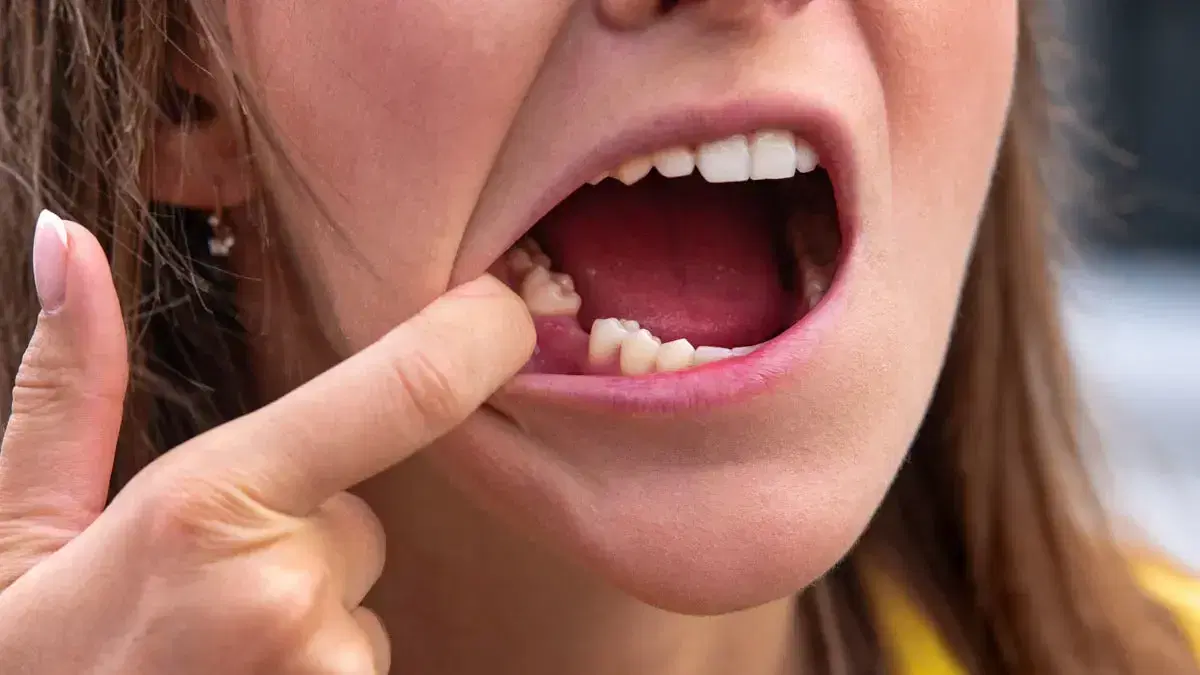
Is an Implant or Bridge Better for a Missing Tooth?
An implant is often more conservative for one missing tooth with healthy neighboring teeth, while a bridge can be practical when those teeth already need crowns.
A single implant replaces the missing tooth without preparing adjacent teeth for full-coverage restorations. A conventional bridge instead uses neighboring teeth as abutments, which usually requires substantial tooth preparation. This difference becomes less important when those teeth already contain large restorations or need crowns for structural reasons. Both approaches have demonstrated good long-term survival. Treatment choice should therefore reflect the condition of the neighboring teeth, available bone, surgical suitability, treatment duration, and maintenance requirements.
What Is a Dental Implant?
A dental implant replaces a missing tooth with a fixture placed in the jawbone and a separate restoration attached above it.
The implant fixture usually supports an abutment and individual crown when a single tooth is missing. Unlike a conventional bridge, the restoration does not require neighboring natural teeth to carry the missing tooth. Implant treatment does involve surgery and requires adequate bone and healthy surrounding tissues. Healing is also needed before or during restoration, depending on implant stability and the treatment protocol. Long-term studies show high survival for implant-supported single crowns, although biological and mechanical complications can still develop over time.
What Is a Dental Bridge?
A conventional dental bridge replaces a missing tooth by connecting an artificial tooth to crowns placed on neighboring natural teeth.
The teeth on either side of the gap usually act as abutments and support the entire restoration. Preparing these teeth creates space for the crowns and establishes the shape needed to retain the bridge. Treatment avoids implant surgery and can often be completed faster because osseointegration is unnecessary. However, the health of each supporting tooth becomes important to the survival of the whole bridge. Decay, root problems, periodontal disease, or fracture affecting an abutment can therefore influence the complete restoration.
Which Option Is Better When the Adjacent Teeth Are Healthy?
An implant is generally the more tooth-conserving option when a single tooth is missing and the neighboring teeth are intact and healthy.
Conventional bridge preparation removes natural tooth structure from both abutment teeth to provide space for crowns. An implant can avoid this preparation because the missing tooth receives independent support from the jawbone. Preserving enamel, dentin, pulp, and periodontal tissues has long been an important consideration when choosing a single-tooth replacement. Implant placement must still respect neighboring roots because poor implant positioning can damage adjacent teeth. Healthy neighboring teeth therefore favor implant treatment when anatomy and surgical conditions are suitable.
When Can a Dental Bridge Make More Sense?
A bridge can make more sense when neighboring teeth already require crowns, implant surgery is unsuitable, or a shorter non-surgical treatment is preferred.
If adjacent teeth contain large restorations, fractures, or extensive structural damage, preparing them as bridge abutments may sacrifice less healthy tissue. A bridge can also avoid bone augmentation when local anatomy makes implant placement difficult. Certain medical conditions, medication-related risks, severe anatomical limitations, or unwillingness to undergo surgery can further shift treatment toward a bridge. Treatment is usually completed without waiting for implant osseointegration, making the overall process shorter when rapid fixed tooth replacement is an important consideration.
What Factors Favor an Implant or a Bridge?
The most useful comparison considers the condition of the entire missing-tooth site rather than judging implants and bridges by one advantage alone.
Healthy untouched neighboring teeth often favor implant treatment
Heavily restored neighboring teeth can make a bridge reasonable
Adequate bone simplifies implant placement
Major bone deficiency can increase implant treatment complexity
Avoiding surgery can favor a bridge
Preserving adjacent tooth structure can favor an implant
Shorter treatment time can favor a bridge
Independent replacement of one tooth can favor an implant
Existing periodontal disease affects both options
Long-term cleaning ability matters with either restoration
Which Lasts Longer, an Implant or a Bridge?
Both implants and conventional bridges can function beyond ten years, and available evidence does not support a simple lifetime guarantee for either treatment.
A major comparative meta-analysis estimated 10-year survival around 89.4 percent for implant-supported single crowns and 89.2 percent for conventional tooth-supported bridges. These values represent older pooled evidence and should not be interpreted as identical modern outcomes in every population. Newer implant research continues to report high long-term survival, while tooth-supported restorations also perform well when supporting teeth remain healthy. Survival differs from being complication-free because crowns, screws, abutment teeth, or supporting tissues may require treatment without complete restoration failure.
Which Treatment Takes Longer?
Dental implant treatment usually takes longer because surgical placement and biological healing can extend treatment over several months.
A conventional bridge can often move from tooth preparation to final restoration without waiting for bone integration. Implant treatment may include extraction healing, implant placement, osseointegration, temporary restoration, and final crown placement. Bone grafting can extend this timeline further when the ridge lacks sufficient volume. Immediate placement or temporary teeth can shorten some stages in selected situations, but they do not eliminate biological healing. A bridge therefore generally offers the shorter pathway, while an implant involves a longer process designed around independent support from the jawbone.
Does an Implant Preserve Jawbone Better Than a Bridge?
Implants transfer functional loading into the jawbone, but current comparative evidence does not prove that they consistently prevent ridge resorption better than conventional prosthetic treatment.
Loss of a natural tooth changes the surrounding alveolar ridge, and implant placement can influence local bone remodeling. However, a systematic review comparing implant-supported and conventional rehabilitation found insufficient evidence for a clear overall advantage in preserving alveolar bone. This is important because the claim that implants always prevent bone loss is too absolute. Local bone changes depend on extraction timing, anatomy, implant position, periodontal health, loading, and other biological factors.
Which Is Easier to Clean, an Implant or a Bridge?
A single implant crown can often be cleaned more like an individual tooth, while a bridge requires cleaning beneath the artificial tooth joining its abutments.
Normal floss cannot pass vertically between connected bridge units. Cleaning therefore requires floss threaders, interdental brushes, or other methods that reach beneath the pontic. A single implant crown usually has accessible contact areas, although peri-implant tissues still require careful plaque control. Neither treatment eliminates the need for maintenance. Implants can develop peri-implant inflammation, while bridge abutment teeth remain vulnerable to decay and periodontal disease. Long-term success therefore relies on daily cleaning around whichever restoration is selected.
What Problems Can Occur With Dental Implants?
Dental implants can develop peri-implantitis, bone loss, crown fracture, screw loosening, implant fracture, aesthetic problems, or failure of osseointegration.
Peri-implantitis is particularly important because inflammation around the implant can progressively reduce supporting bone. Published prevalence estimates vary considerably because diagnostic definitions differ between studies. Mechanical complications may occur even when the implant fixture remains firmly integrated. Restoration repair therefore does not always mean implant failure. Smoking, previous periodontal disease, poor plaque control, and inadequate maintenance can increase biological risk. These complications explain why an implant should not be regarded as a maintenance-free replacement simply because it cannot develop conventional tooth decay.
What Problems Can Occur With a Dental Bridge?
A dental bridge can develop decay beneath its supporting crowns, periodontal problems, ceramic fracture, loss of retention, or failure of an abutment tooth.
The bridge relies on its supporting teeth, so deterioration of one abutment can affect the complete restoration. Full-coverage preparation also permanently changes those teeth. If an abutment later develops pulpal disease, root fracture, severe decay, or periodontal breakdown, further treatment may become necessary. Modern tooth-supported restorations can still achieve good long-term survival when abutments are appropriately selected. The central tradeoff is that a bridge avoids implant surgery while placing additional restorative responsibility on neighboring natural teeth.
Is an Implant or Bridge Better for a Front Tooth?
An implant can provide an independent front-tooth replacement, while a bridge can provide excellent aesthetics when implant anatomy or neighboring tooth conditions favor a tooth-supported solution.
Anterior implants require precise three-dimensional positioning because bone, gum shape, papillae, and neighboring roots directly affect appearance. Poor positioning can produce recession, asymmetry, or damage to adjacent teeth. A bridge avoids implant placement within the aesthetic zone but requires preparation of supporting teeth. Resin-bonded bridges can also offer a more conservative option in selected anterior cases. The most suitable approach therefore considers tissue architecture and neighboring tooth condition alongside the desired final appearance.
What Happens if There Is Not Enough Bone for an Implant?
Insufficient jawbone can make implant placement more complex because the fixture needs adequate surrounding bone for stable and maintainable positioning.
Bone augmentation, ridge preservation, sinus augmentation, or a different implant design may be considered when local dimensions are inadequate. These additional procedures can increase treatment stages and healing time. A bridge can bypass the need for an implant at the missing-tooth site because support comes from neighboring teeth. However, avoiding grafting does not automatically make the bridge superior if those neighboring teeth are otherwise healthy. Bone quantity is therefore one part of the comparison rather than an isolated reason to choose one restoration.
Is an Implant More Expensive Than a Bridge?
A single implant crown usually has a higher initial treatment cost than a conventional bridge, although long-term economic comparisons depend on maintenance and future treatment.
A 20-year cost-effectiveness model found that implant-supported single crowns had higher cumulative costs than tooth-supported fixed prostheses while providing a higher quality-adjusted prosthesis value. The analysis also showed that the most cost-effective choice was not straightforward. Replacement crowns, bridge repairs, abutment treatment, implant maintenance, bone grafting, and complications can all alter lifetime expenditure. Comparing only the initial invoice therefore gives an incomplete picture of the economic difference between these two treatments.
Is an Implant or Bridge Better for Several Missing Teeth?
The preferred solution for several missing teeth depends on the number and position of gaps because treatment may involve multiple implants or implant-supported bridges.
Replacing every missing tooth with a separate implant is not always necessary. Research on adjacent missing anterior teeth shows that one implant supporting a two-unit cantilever restoration can achieve high short-term to mid-term survival in selected situations. Two individual implant crowns can also perform well. Conventional tooth-supported bridges remain possible when suitable natural abutments are available. As the number of missing teeth increases, treatment planning becomes less about one implant versus one bridge and more about distributing support effectively across the dental arch.
How Should You Decide Between a Dental Implant and a Bridge?
The decision should prioritize preservation of healthy teeth, available bone, surgical suitability, treatment time, hygiene, and the long-term condition of supporting tissues.
For one missing tooth between untouched healthy teeth, an implant often avoids unnecessary preparation of neighboring structures. A bridge becomes more attractive when those teeth already need substantial restorations or implant surgery creates unnecessary complexity. Neither option is universally more durable or complication-free. Long-term evidence shows that both can provide successful fixed tooth replacement. The most useful comparison therefore asks which approach preserves the strongest remaining structures while creating a restoration that can be cleaned, maintained, and repaired predictably over time.